
Corporate Counsel
29 January 2026
Raising IPO Thresholds in Türkiye (2026)
2 February 2026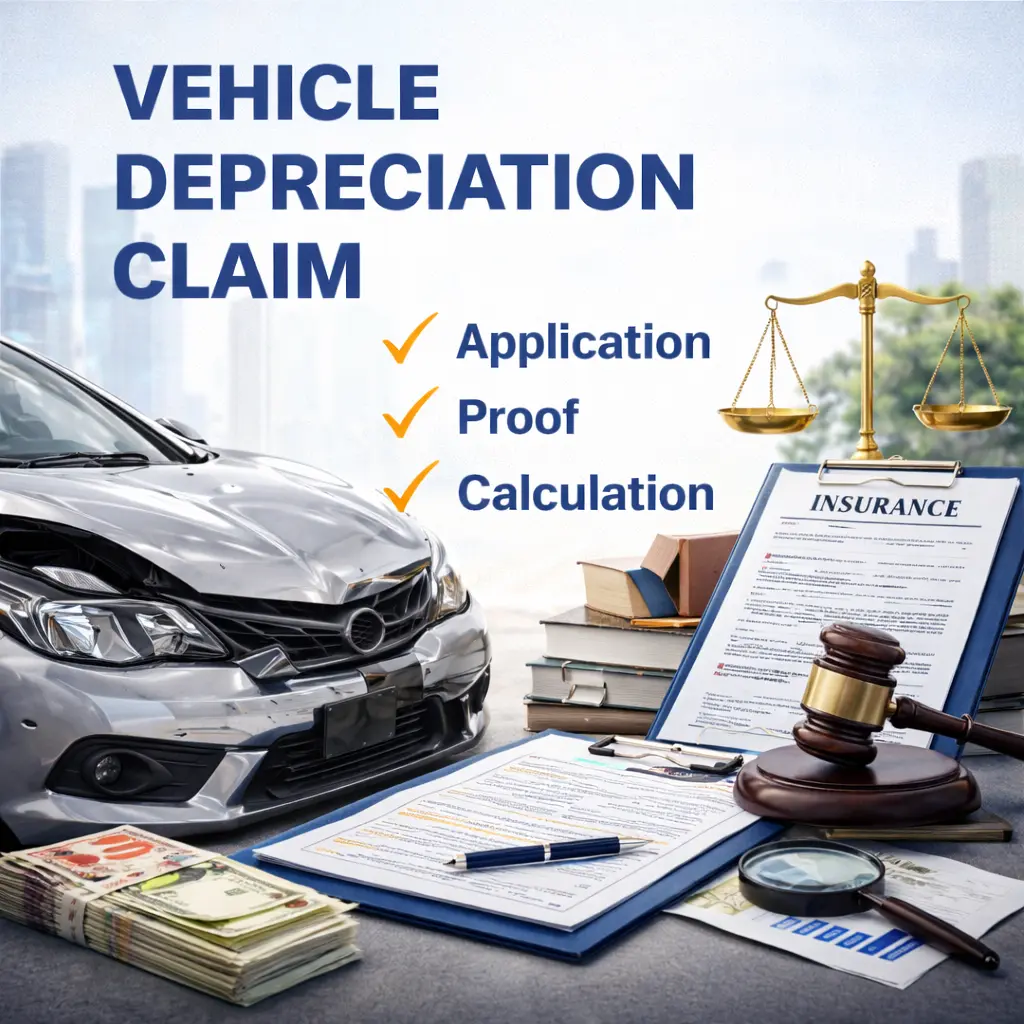
1) What is vehicle depreciation (diminution in value) and what does it compensate?
After a traffic accident, even if a vehicle is fully repaired, it may not sell for the same price on the second-hand market. This is driven by factors such as an accident record, replaced parts, paint/workmanship traces, the possibility of repairs on critical areas (e.g., chassis/pillars), and buyer behavior. Practically, this market loss is the difference between the vehicle’s market value before the accident and its market value after the accident (post-repair). Depreciation compensation aims to cover this difference (taking the fault ratio into account).
Depreciation is often confused with:
- Repair cost (damage compensation): service/labor/parts costs
- Replacement vehicle / loss of use: compensation for the period the vehicle could not be used
- Incomplete/defective repair: additional loss due to technically insufficient repair
- Depreciation: loss caused by the “accident history” effect in the market even if the repair is perfect
2) Legal basis and who is liable?
Depreciation is a head of pecuniary damage arising from a traffic accident. In general:
- Primary liable parties: the at-fault driver, the operator (vehicle owner/operator), and in certain cases the enterprise to which the operator is connected, etc.
- Compulsory traffic insurance (ZMSS): within policy limits, covers third parties’ pecuniary losses under the at-fault vehicle’s policy.
In most cases, the claim is first directed to the at-fault vehicle’s traffic insurer; if payment is not made or is insufficient, the Insurance Arbitration Commission or litigation becomes relevant.
3) Mandatory pre-action application to the insurer and waiting period
If depreciation is claimed under traffic insurance, the step of submitting a written application to the insurer is critical and, in practice, treated as a precondition. The Insurance Arbitration Commission clearly states: a written application must be made to the insurer; if the insurer does not satisfy the claim or does not provide a written response within 15 days(for traffic insurance), an application may be filed with the Commission.
Proof of the application and the expiry of the 15-day period (registered mail receipts, courier delivery records, notary notice, email records, document registration date, etc.) often determines the fate of the file.
4) Insurer’s payment period and the “missing documents” problem
Under the ZMSS General Terms, insurers frequently rely on “missing documents” arguments. The General Terms include a rule that compensation must be paid within 8 business days from the date the necessary documents reach the insurer.
Therefore, two points are crucial in practice:
- Submitting the basic documents complete with the application,
- Requesting the insurer’s missing-document demand in writing where possible and keeping the process on record.
5) Conditions for a depreciation claim (core practical criteria)
Depreciation does not arise automatically in every incident. The assessment typically turns on:
A) Causation between accident–damage–repair
- It must be shown that the damage arose from the accident, was repaired, yet still caused a market value drop.
- If there is a prior damage record on the same area, disputes arise about the “impact of prior damage.”
B) Nature of the damage
- If work was performed on structural/carrier parts (e.g., chassis, pillars, apron/strut towers, roof panel, rocker panels), depreciation is usually more pronounced.
- For “bolt-on” parts (e.g., bumper/headlight) and superficial paintwork, depreciation may be limited (but not necessarily zero; market behavior matters).
C) Market segment and market value at the accident date
- The same damage can produce higher depreciation in luxury segment and/or newer vehicles.
D) Fault ratio
- If the damaged party is not 100% faultless, depreciation is reduced proportionally.
6) Calculation approach: the “formula era” and post-2025 debates
6.1) General Terms Annex-1 (formula-based approach) – how it worked
Annex-1 of the ZMSS General Terms set out the procedures and principles for calculating depreciation. Under this approach:
- Depreciation is calculated via a separate depreciation report prepared by the insurance adjuster/expert.
- The vehicle’s market value is determined using the average of the TSB Motor Insurance Vehicle Value List and the TOBB Insurance Adjusters Executive Committee Market Value List (or the single available list value).
- Parameters such as a usage coefficient (K) are determined based on mileage/operating hours.
- A damage coefficient is built from sub-components such as part replacement/repair and paint coefficients (with detailed tables in Annex-1).
- Factors like commercial/rental use and SBM claims history are also reflected through coefficients.
While intended to ensure uniformity, this method faced strong criticism for allegedly failing to reflect the actual market loss.
6.2) Council of State (Danıştay) decision in 2025: annulment of Annex-1 and its implications
The 8th Chamber of the Council of State annulled certain provisions introduced by the 04.12.2021 amendments and also annulled Annex-1 titled “Depreciation Compensation Calculation”; the decision also states that appeal is available.
The reasoning indicates that, following Constitutional Court annulments concerning the framework in Highway Traffic Law (KTK) Art. 90, the legal basis for determining procedure and principles through general terms weakened, and there is a risk that the principle of full compensation (“actual loss”) could be eroded to the detriment of the injured party.
The Union of Turkish Bar Associations also announced on 25.07.2025 that the Council of State annulled certain provisions as well as Annexes 1, 2, and 3.
Practical impact (as of 2026):
- In arbitration and court files, the question of which calculation method should apply has become more contested.
- Instead of strict adherence to the formula, expert/adjuster assessments grounded in market data and the specifics of the case—aiming at the “actual loss”—may gain prominence.
6.3) SEDDK step on 12.11.2025: update of the depreciation expert report template
In its press release dated 12/11/2025, SEDDK announced that the “Depreciation Expert Report” was updated, and that the new template aims—consistent with judicial decisions and within the principle of actual loss—to determine and compensate the real damage.
Practically, this signals a move toward more market-based and better-reasoned reports and standardization in reporting.
7) Proof and file preparation: which documents are essential?
In depreciation files, the documents most often missing—and most frequently challenged by insurers—include:
- Accident report / traffic police report
- Fault assessment (TRAMER/SBM, expert report, court expert report)
- Vehicle registration copies (both vehicles)
- Repair documents: service invoices, work orders, parts list, replaced parts, paint information
- Expert reports (damage/repair)
- Photographs: damaged condition, repair phase, post-repair
- Mileage (as of the accident date)
- Prior damage records (to manage the dispute)
- Depreciation report (private expert report or court expert report)
The Insurance Arbitration Commission’s application pages also clearly state that the insurer’s final response letter (or proof of no response within 15 days) and supporting documents must be submitted together.
8) Application and follow-up strategy: Insurer – Arbitration – Litigation
8.1) Application to the insurer (mandatory first step)
- Submit a written application (supporting it with email + registered mail/courier or notary notice is advisable).
- State the claimed amount; attach supporting documents; provide IBAN.
- Calendar the 15-day waiting period (15 days under traffic insurance).
8.2) Arbitration route (aiming for quicker outcomes)
- You may apply if the insurer rejected the claim or did not respond within 15 days.
- The application form, proof of application fee payment, ID documents, and insurer correspondence must be complete.
Because arbitration often proceeds quickly on the file, the quality of the initial submission is critical.
8.3) Litigation route (especially for higher amounts / complex expert review)
- In some cases (multi-party accidents, serious fault disputes, prior damage arguments, commercial vehicle usage conditions, etc.), court proceedings may allow broader examination via court-appointed experts.
- Proof that the pre-application requirement to the insurer has been fulfilled is essential; otherwise, procedural issues may arise.
9) Most common objections in practice and how to address them
Objection 1: “The vehicle is old / high mileage; there is no depreciation.”
Response: Depreciation may be lower in older/high-mileage vehicles, but it is not correct to say it never exists in every case. The market value and damage nature must be concretely demonstrated.
Objection 2: “The damage is minor; there is paint but no depreciation.”
Response: Buyer perception of “paint/replaced parts” affects segments differently. Clarify the nature of damage with photos, invoices, and parts lists.
Objection 3: “There was prior damage; the depreciation stems from that.”
Response: Separate prior damage by location and nature from the new damage; where possible, use comparative market analysis and an expert report.
Objection 4: “Documents are missing; the period has not started.”
Response: Document delivery/registration of the application; request the insurer’s missing-document list in writing; complete reasonable requests. (The 8-business-day payment rule is often tied to the “necessary documents” debate.)
10) Interest and claim management
Interest discussions in depreciation claims vary depending on the application date, default (temerrüt), the insurer’s response date, and the start date accepted by the court/arbitration panel. Two practical recommendations:
- Clearly specify the interest request in the application/petition (from which date).
- Submit an evidentiary application that puts the insurer in default (courier delivery, notary, registration records).
11) The “current picture” for 2026: how should the file be structured?
Reading the 2025 Council of State decision together with SEDDK’s updated report template suggests that a strong 2026 file rests on three pillars:
- Actual loss narrative (market-based):
- Pre-accident market value supported with concrete market data,
- Nature of damage (replaced/painted/repaired parts and type of repair),
- Expected drop in the second-hand market after the accident with reasoned analysis.
- Proof chain and record discipline:
- Clear proof of application and the 15-day waiting period,
- Complete repair file, photographs, and parts lists.
- Report quality:
- Expert/adjuster report explaining the “why,”
- Not merely a table, but grounded in the specifics of the case,
- Reasoning aligned with current judicial approach (SEDDK’s emphasis on “actual loss” strengthens this).