Raising IPO Thresholds in Türkiye (2026)
2 February 2026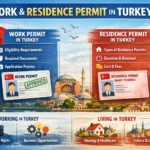
Turkey Work Permit and Residence Permit Guide for Foreigners Living in Türkiye
3 March 2026
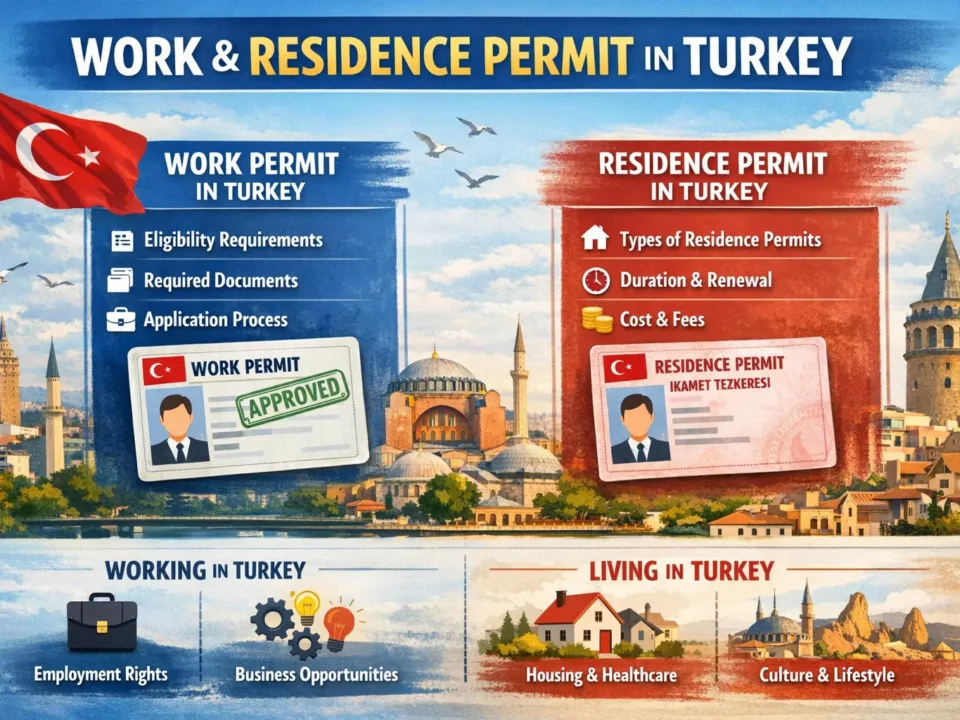
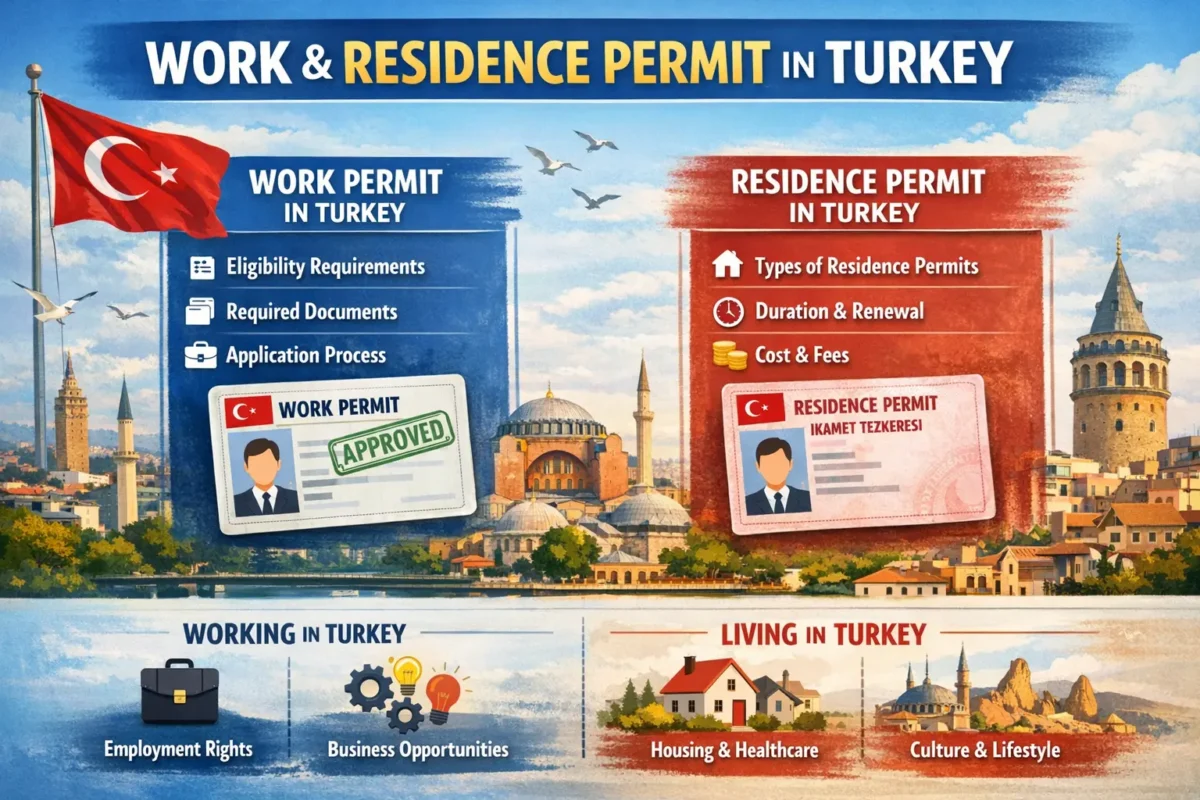
1. Two separate legal regimes: the right to stay vs. the right to work
In Türkiye, a foreign national’s legal status is shaped by two core permits:
- Residence permit (ikamet / “oturum”): grants the right to stay in Türkiye under a specific status for a defined period (Law No. 6458 on Foreigners and International Protection).
- Work permit: is the legal precondition for paid work (or certain forms of independent work) in Türkiye (Law No. 6735 on International Labour Force).
A frequent practical mistake is treating these two regimes as interchangeable:
- “I have a residence permit, so I can work.” → As a rule, this is incorrect.
- “I obtained a work permit; I must also obtain a separate residence permit.” → In many scenarios, this is also incorrect (subject to status-specific nuances).
2. The work permit as a substitute for the residence permit: still the key rule in 2026
A central principle under Law No. 6735, Article 12 is that a work permit (or work permit exemption) issued under this law is deemed to be a residence permit substitute within the framework of the residence-permit regime.
Practical implications:
- A foreign national holding a valid work permit generally has a lawful basis to reside in Türkiye without obtaining a separate residence permit card solely for the purpose of lawful stay.
- Nevertheless, because exceptions and status-specific rules may apply (especially for certain protection statuses or special categories), the “residence substitute” effect must be verified case-by-case.
- In practice, authorities also emphasize address registration / notification and other administrative obligations; neglecting these can cause downstream risk even when the core permit is valid.
3. The residence permit side: application logic and where files typically fail
3.1. The most frequently encountered residence-permit categories
In daily practice, search demand and case volume concentrate on:
- Short-term residence permits (touristic, property ownership, commercial connection, etc.)
- Family residence permits
- Student residence permits
- Long-term residence permits
3.2. The e-residence (e-ikamet) file logic: what the administration tests for
In residence-permit files, the administration tends to examine the internal consistency of four core elements:
- Application form statements and declarations
- Supporting documents
- Fees / card payments
- Address and accommodation documentation
Where risk increases materially (especially in short-term applications):
- Health insurance that does not cover the requested period or fails compliance checks
- Mismatch between address declarations and documentary proof
- A stay purpose that remains abstract (insufficiently supported by concrete documentation), particularly in touristic filings
4. The work permit side: application types, evaluation criteria, and employer obligations
4.1. Main application tracks: abroad vs. inside Türkiye
There are two primary routes:
- Application from abroad: initiated through a consulate/mission and completed through the employer’s online work-permit process.
- Application from within Türkiye: typically available to foreign nationals who are already in Türkiye with a valid residence status meeting the “domestic filing” threshold.
4.2. Evaluation criteria: “complete documents” is not enough
Work-permit outcomes are shaped not only by document completeness but also by evaluation criteria focusing on:
- Employment and workforce structure
- Financial sufficiency and operational reality
- Salary/position alignment and justification
Accordingly, a legally robust strategy is to:
- Demonstrate the role’s necessity and the foreign national’s qualifications in a concrete way
- Support employer reality with readable evidence (organization, activity, operations, business plan logic)
- Align salary and role with the evaluation criteria through a coherent narrative and supporting exhibits
4.3. Unauthorized work: the most significant practical risk in 2026 as well
Working without authorization (or employing without authorization) is not only a matter of administrative fines; it also undermines long-term permit sustainability and can negatively affect future filings. A compliance-first approach is therefore a legal strategy, not merely an HR preference.
5. 2026 fees and payments: avoid losing the file on a purely financial technicality
Fee-related issues commonly cause preventable setbacks. Best practice is to treat payments as a compliance checkpointrather than a last-minute administrative detail.
5.1. Residence permit: payment logic and file hygiene
Residence-permit payments often include multiple items (e.g., permit fee + card fee). The key risk is underpayment, miscalculation, or timing mismatch.
5.2. Work permit: fee structure by duration + card-related charges
Work-permit fees typically vary by duration and permit type. For 2026, the practical point is not the exact number (which can change by official tariff) but ensuring:
- You apply the correct tariff to the correct permit type and duration,
- Payments are completed within the required timeline,
- Proof is properly uploaded/retained.
6. Refusal, cancellation, and non-extension: correct concept, correct timeline, correct strategy
In the residence-permit regime, refusal, cancellation, and non-extension may feel similar in outcome, but they can differ materially in legal reasoning and the defense strategy.
A practical legal workflow:
- Identify the administration’s core justification (document issue, purpose credibility, address/insurance mismatch, public-order evaluation, etc.).
- Build the notification–deadline–evidence chain carefully.
- Determine the most appropriate combination of administrative remedies and judicial options based on the decision type and procedural posture.
7. Ten practical checkpoints that keep files alive
- Purpose–document alignment (especially in short-term residence cases)
- Insurance period and scope alignment
- Address/accommodation proof matching the declared facts
- Payment completeness (fees/card costs)
- Employer compliance with evaluation criteria (financial and employment-related)
- Clear job description, necessity, and qualification mapping
- Salary and role alignment under applicable criteria
- Timely social security/notification obligations (where applicable)
- Rapid justification analysis and deadline management after an adverse decision
- Avoiding status conflicts across visa/residence/work tracks
In 2026, residence and work permits must be handled as two distinct legal regimes with a crucial intersection: the work permit’s “residence substitute” effect. Successful filings are not simply “form completion”; they are the coherent construction of legal status, documentary consistency, and criteria-based compliance.