Turkey Work Permit and Residence Permit Guide for Foreigners Living in Türkiye
3 March 2026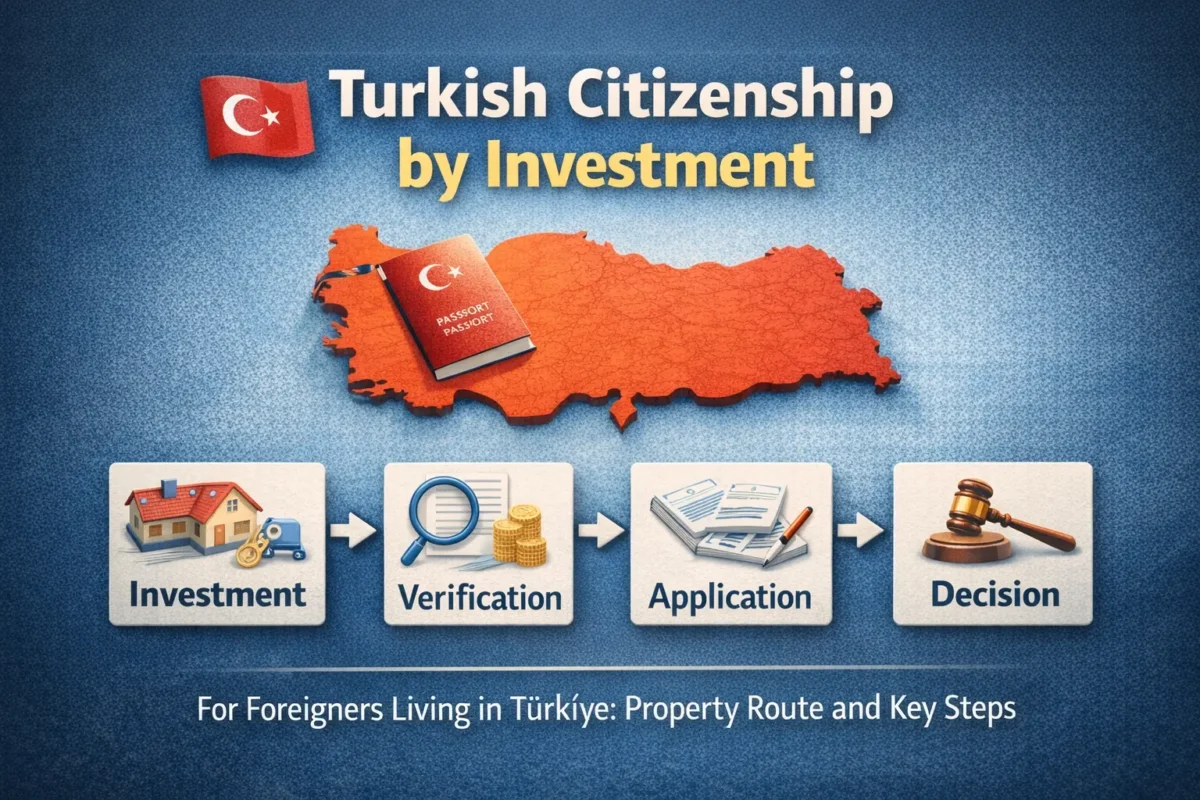
Foreign nationals living in Türkiye often search for a clear, reliable roadmap on “Turkey citizenship by investment,” “Turkish citizenship by property,” and “how to get a Turkish passport by investment.” This article explains what the program is, the main qualifying routes, the legal structure behind it, and the practical steps that usually determine whether an application moves smoothly or gets delayed.
1) What “citizenship by investment” means in Türkiye
Türkiye allows exceptional acquisition of Turkish citizenship for foreigners who meet specific investment conditions. In practice, this is commonly referred to as “Turkish citizenship by investment (TCBI).” The most frequently used route is real estate, but several other investment options exist.
A key point for investors: the program is not “automatic.” It is a legal process that requires (i) a qualifying investment, (ii) formal verification/attestation of that investment by the competent authority, and (iii) a citizenship application evaluated under the exceptional procedure framework.
2) The most common route: Turkish citizenship by property purchase
For citizenship by real estate investment, Türkiye’s Investment Office states that a foreign national may apply through exceptional procedures by purchasing real estate worth USD 400,000 or more and committing not to sell it for three years.
This is why many high-intent searches in Türkiye look like:
- “Turkey citizenship by investment 400,000”
- “buy property in Turkey get citizenship”
- “Turkish citizenship by property 3 year rule”
- “title deed annotation not to sell 3 years”
What typically matters in practice:
- The valuation must support the required threshold (the valuation is central to eligibility).
- The title deed / Land Registry process must reflect that the purchase is for citizenship purposes and include the 3-year sale restriction (annotation).
3) Other qualifying investment options (common alternatives)
Beyond real estate, Türkiye also recognizes other investment types under the citizenship-by-investment framework. Market-standard summaries (used by global advisory firms) list several routes commonly referenced at USD 500,000thresholds, such as bank deposit, fixed capital investment, government bonds, fund shares, and certain pension/system options, typically with a 3-year holding condition.
In real life, these alternative routes are often chosen when:
- The applicant prefers a financial instrument rather than a property purchase,
- The applicant wants portfolio flexibility (within the holding restrictions),
- The applicant needs a structure better aligned with family planning, business planning, or risk profile.
4) Legal backbone (how to reference this correctly in a legal article)
A properly framed legal article generally references:
- Turkish Citizenship Law No. 5901 (the main citizenship statute; exceptional acquisition is anchored here), and
- The Regulation on the Implementation of the Turkish Citizenship Law (commonly cited for the investment routes and technical conditions—especially around real estate values, holding restrictions, and verification procedures).
Practical takeaway: most disputes and delays are not about “whether the program exists,” but about technical compliancewith the implementing regulation and verification requirements.
5) Step-by-step process (high-level, investor-friendly)
While the exact sequence can vary, investors usually succeed by following this order:
Step 1 — Choose the route (property vs deposit vs other).
If you select real estate, plan the purchase around valuation, title deed, and compliance requirements. If you select bank deposit or other instruments, plan around holding/attestation and documentation.
Step 2 — Complete the qualifying investment correctly.
For property purchases, this includes the correct Land Registry workflow and ensuring the sale restriction is properly placed.
Step 3 — Obtain the required verification/attestation (“conformity” style verification).
The investment must be confirmed by the relevant authority for that route (real estate vs banking vs capital investment).
Step 4 — Submit the citizenship application under the exceptional procedure.
This stage is highly document-driven. Translation, notarization, and consistency across documents matter.
Step 5 — Family inclusion (if applicable).
Commonly, spouses and dependent children are included, but eligibility rules and documentation must be handled carefully.
6) Common compliance pitfalls (what causes rework or delays)
These are the issues behind searches like “Turkish citizenship by investment rejected” or “citizenship by property application delayed”:
- Valuation mismatch or timing issues
If the valuation does not meet the threshold, or if documents are not aligned with the required timeline, the file can stall. - Title deed annotation errors (3-year restriction)
If the “not to sell for 3 years” restriction is missing, incorrectly recorded, or inconsistent with the investment purpose, it becomes a structural problem. - Payment and banking traceability gaps
Authorities usually expect clean, traceable payment flows consistent with the program rules and the applicant’s file. - Assuming any property qualifies “as is”
Even if the property is valuable, the eligibility is tied to how the purchase is documented and validated.
7) Strategic note for foreigners living in Türkiye
Many applicants live in Türkiye on a residence permit and aim to transition to citizenship through investment. The strongest approach is to treat this as a compliance project:
- plan the investment route,
- lock in documentation standards early,
- and avoid “shortcuts” that create later contradictions across valuation, title deed, and financial records.
8) ConclusionTurkish citizenship by investment remains a structured, rules-based pathway—most often via USD 400,000+ real estate with a 3-year holding restriction.
Success depends less on the headline amount and more on technical compliance: valuation, title deed annotations, traceable payments, and a clean documentation set aligned with the implementing regulation framework.