What to Do If You Have Signed a Blank Promissory Note?
16 December 2025
Compensation for Loss of Financial Support in Fatal Traffic Accidents
27 December 2025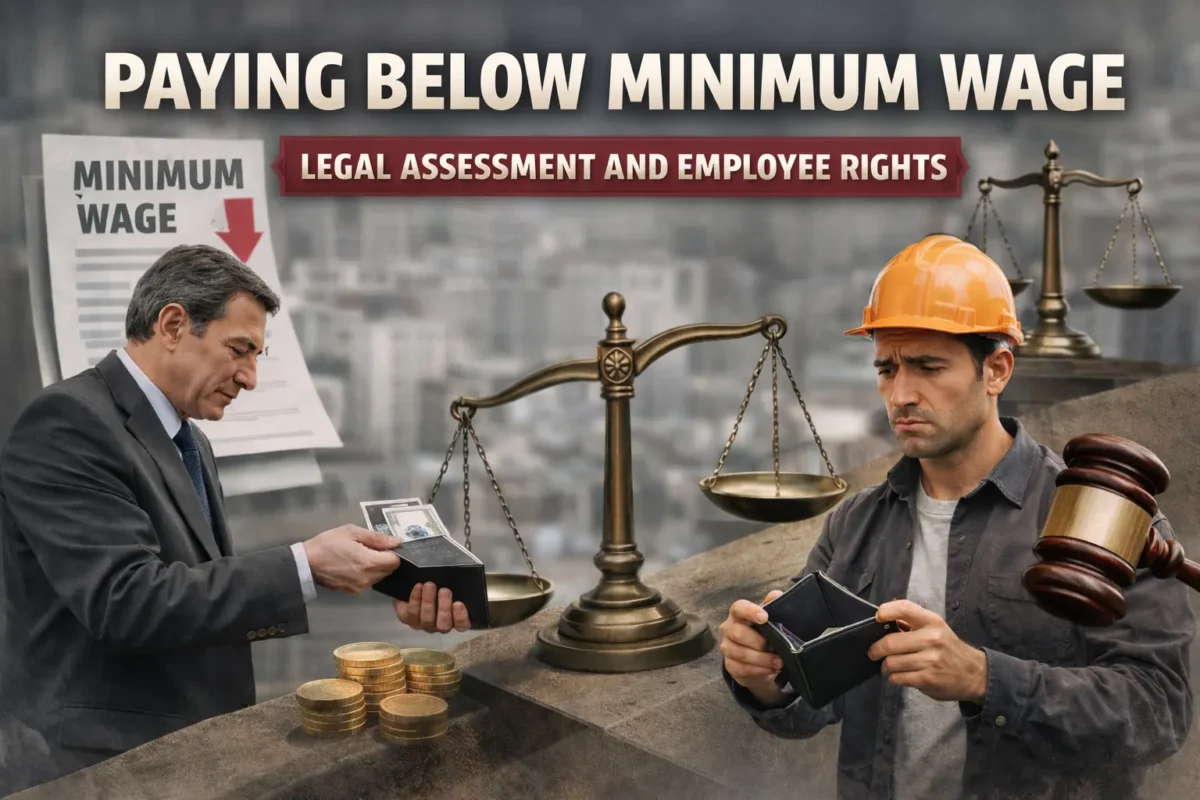
In employment relationships, wages constitute one of the core obligations between the employee and the employer. For this reason, the determination and payment of wages are not left solely to the will of the parties but are subject to legal regulation due to their public order dimension. At the forefront of these regulations stands the minimum wage.
The minimum wage represents the legally guaranteed lowest level of remuneration that must be paid to employees to ensure a decent standard of living. Paying wages below this threshold is not merely a contractual breach but constitutes a violation of mandatory legal provisions. Such practices give rise to various legal remedies for employees and may result in administrative and judicial sanctions for employers.
This article examines the legal nature of the minimum wage, the consequences of paying wages below this level, and the legal remedies available to employees.
Legal Nature and Binding Effect of the Minimum Wage
The minimum wage is defined as the lowest amount of remuneration that must be paid to an employee in return for work performed and cannot be reduced by agreement between the parties. In Türkiye, the minimum wage is determined through a statutory mechanism and enters into force upon official publication.
One of the fundamental principles of labour law is the principle of employee protection, which forms the legal basis of minimum wage regulations. This principle acknowledges the inherent imbalance of bargaining power between employers and employees and aims to safeguard the employee’s basic living conditions.
Accordingly, any agreement providing for wages below the minimum wage is deemed legally invalid. Even if such a provision is included in an employment contract with the consent of the employee, it is considered null and void, and the employee retains the right to claim the statutory minimum wage.
Legal Consequences of Paying Wages Below the Minimum Wage
The payment of wages below the minimum wage entails multiple legal consequences that go beyond the mere recovery of unpaid wage differences.
Claims for Wage Differences
An employee is entitled to claim the unpaid portion of the minimum wage for the period during which they worked. Such claims may be asserted retroactively within the applicable limitation periods. The fact that the employee has signed payroll records does not, in itself, constitute a waiver of this right, particularly where the payroll does not reflect the actual wage paid.
In cases where the recorded wage differs from the wage actually received, the true amount may be established through witness statements and other admissible evidence.
Right to Terminate the Employment Contract for Just Cause
The unlawful underpayment of wages constitutes just cause for immediate termination by the employee. In such circumstances, the employee may terminate the employment contract without notice and, provided that statutory conditions are met, become entitled to severance pay.
Although the termination is initiated by the employee, the legal consequences are attributed to the employer due to the employer’s breach of statutory obligations.
Administrative and Judicial Sanctions
If underpayment is identified through administrative inspections, employers may be subject to administrative fines. In addition, court proceedings initiated by the employee may result in judgments ordering the payment of wage differences together with statutory interest.
Common Misconceptions and Unlawful Practices
Certain practices frequently encountered in practice do not render payment below the minimum wage lawful. These include, in particular:
- Payment of part of the wage in cash without record,
- Showing the minimum wage on payroll while paying a lower amount in practice,
- Attempting to justify a lower base wage by reference to bonuses, premiums, or fringe benefits such as meal or transportation allowances.
Such additional benefits cannot replace the minimum wage obligation. The minimum wage must be paid as a base (gross) wage, and supplementary payments do not legitimize underpayment.
Legal Remedies Available to Employees
Employees who are paid below the minimum wage may pursue several legal and administrative remedies. These remedies are complementary rather than mutually exclusive.
Primarily, employees may apply to mandatory mediation procedures to seek recovery of unpaid wages. If mediation fails to result in an agreement, the dispute may be brought before the competent labour courts. In parallel, administrative complaint mechanisms may be used to trigger inspections and sanctions.
In these processes, the employee bears the burden of proving the duration of employment and the actual wage received. Written documents, as well as witness testimony, may be relied upon as evidence.
The minimum wage is a mandatory safeguard in employment relationships and cannot be subject to negotiation or waiver. Payment of wages below this threshold is legally invalid and exposes employers to significant administrative and judicial consequences. For employees, such practices give rise to claims for unpaid wages, termination for just cause, and potential entitlement to compensation.
Ensuring that wages are determined and paid in compliance with statutory minimum standards is essential for preventing disputes and maintaining lawful employment relations.